Data report
FBI Cyber Attack Warning: 550 New Security Flaws a Day, Four Times a Year Ago
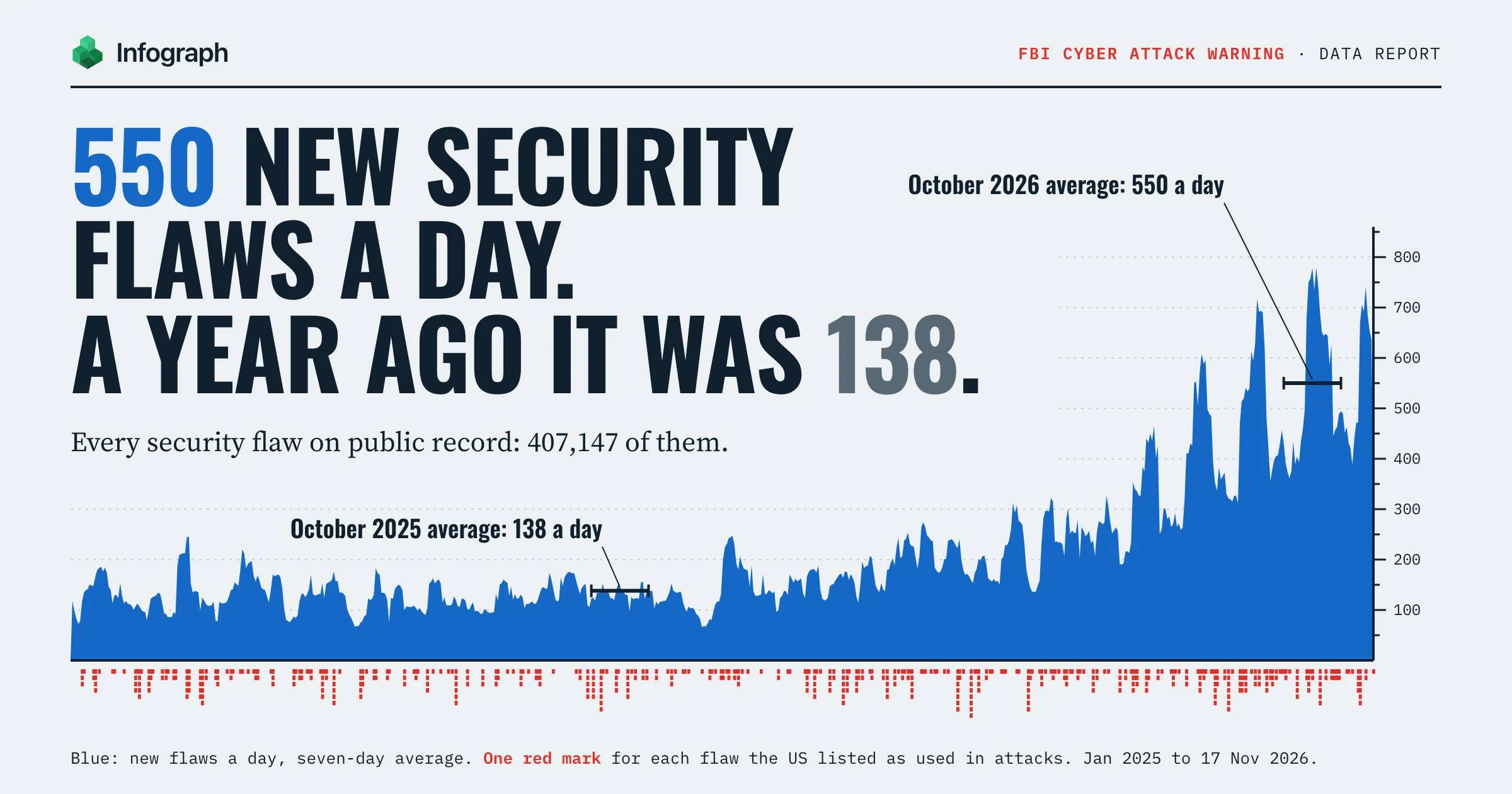
The FBI's AI hacking warning is about speed. The public record shows volume: 550 new security flaws a day in October 2026, up from 138 a year earlier.
Key takeaways
- New security flaws are being published four times as fast as a year ago. October 2026 averaged 550 a day. October 2025 averaged 138. Part of the rise is bookkeeping: two publishers working through old backlogs account for more than a third of this year’s extra flaws.
- On the US government’s list, attackers are no faster than in 2023. This year the typical flaw waited 6.5 days between going public and being listed as used in attacks. In 2023 it waited 4 days. The wait did shorten during 2026, and other counts show attackers speeding up.
- Defenders have less time and less help. The deadline for US federal agencies to fix a listed flaw has gone from 21 days to 3 on most new entries. The national database scored 93% of 2023’s flaws itself. It has scored 15% of this year’s.
Made with Infograph
Crunched the data
407,147 security flaws, the 1,782 on the US list of flaws used in attacks and 123,664 finder credits, from 3 sources
Found the pattern
550 new flaws a day in October 2026 against 138 a year earlier; on the US list, a flaw's typical wait before it is listed as attacked is 6.5 days, against 4 in 2023
Built the report
Connect your apps and databases. Infograph scans gigabytes of data, not just what fits in a chat window, and hands back results.
No credit card required
On Friday 13 November 2026 the FBI sent out an alert about Artex, a free AI tool that runs the steps of a break-in without a person typing each command. One line from it made the headlines. Some intrusions, it said, went “from initial targeting to privileged access in under three hours”.
The three hours is real, and it is narrower than it sounds. It is Microsoft’s observation of one group of attackers, which the FBI’s alert cites. Microsoft also wrote that most of that group’s attempts failed.
So is AI making hacking faster, and is anyone keeping up? Two public records can test it. One holds every security flaw that has ever been given a public number. The other is the US government’s list of the flaws it has caught being used in real attacks. We went through both.
A security flaw is a mistake in software that lets someone in who should not get in. On the government’s list, attackers are no quicker to use a new flaw than they were three years ago. What has changed is how many flaws there are. In October 2026, 550 new ones were published every day. A year earlier it was 138.
- New security flaws published a day in October 2026 (17,051 in the month). October 2025: 138 a day
- 550
- Source: NIST National Vulnerability Database, as of 17 November 2026
- Days a flaw typically waited in 2026 between going public and the US government listing it as used in attacks. In 2023: 4 days
- 6.5
- Source: CISA Known Exploited Vulnerabilities catalog, 252 flaws
- Days federal agencies get to fix 128 of the 165 flaws listed since 10 June 2026. Before March it was usually 21 days
- 3
- Source: Due dates in CISA's catalog
- Of the flaws published in 2026 that the national database's own analysts have scored. Of 2023's: 93%
- 15%
- Source: NIST National Vulnerability Database, as of 17 November 2026
What we analysed in the public flaw records
Three public records hold the answer between them. We read each one in full and crunched them in Infograph:
NIST National Vulnerability Database. US National Institute of Standards and Technology, Flaws published from 1 October 1988 to 17 November 2026. Every published security flaw: the day it went public, how severe it is rated, and whether NIST's own analysts scored it. Rejected records are left out. Flaws are counted by the day they were published. Open the original.
- flaws
- 407,147
- yearly files
- 25
CISA Known Exploited Vulnerabilities catalog. US Cybersecurity and Infrastructure Security Agency, As downloaded on 17 November 2026. The flaws the agency has confirmed are being used in real attacks. Each has the day it was added and the date federal agencies must fix it by. The rows were checked against the catalog's own count. Open the original.
- flaws used in attacks
- 1,782
- added in 2026
- 298
CVE Program record. The CVE Program, Release of 17 November 2026. Who published each flaw, and the credit line that thanks whoever found it. Every credit was searched for the name of an AI model, an AI lab or an AI flaw-hunting tool, and the matches were read. Open the original.
- records
- 426,227
- finder credits
- 123,664
Analysed in Infograph. One row per flaw: the day it went public, who published it, who is credited with finding it and, if it is on CISA's list, the day it was added. Open the interactive report.
What did the FBI warn about?
A tool called Artex. It hands the steps of a break-in to AI models, one after another. Its author published it free in July 2026 for authorised security testing, and took it down on 8 October after reports that attackers were using it. The FBI says copies are still spreading. It says attackers have used Artex since at least August, against organisations in finance, government, healthcare, energy and other fields.
The three hours comes from a Microsoft report in October, which the FBI cites. Microsoft described one group, which it calls Storm-0940, using Artex against hundreds of organisations. In “multiple instances”, it wrote, “the time from initial targeting to privileged access was less than 3 hours”. Privileged access means the attacker has an administrator’s level of control.
The same report says: “While the majority of the targeting wasn’t successful, Storm-0940 achieved privileged cloud persistence at many organizations in a brief time.”
Google and Amazon studied attacks that used Artex, and both say the methods are old ones. Google put it this way: “LLM-enabled offensive tooling does not fundamentally change the techniques attackers use. It reduces the time required to combine them.”
So the warning is about speed inside one victim’s network. The public record measures a different kind of speed: how soon a newly published flaw is being used in attacks. Both can be true at once. Only the second can be checked by anyone.
Are cyber attacks getting faster?
When a flaw is found, it gets a public number, called a CVE, and a publication date. The US cyber agency, CISA, keeps a list of the flaws it has confirmed are being used in real attacks. The list holds 1,782 today. Each one has the date CISA added it.
The time between those two dates is how long a flaw was public before it was a confirmed weapon. For flaws added in 2026, the typical wait was 6.5 days. In 2023 it was 4 days. In 2024 it was 6, and in 2025 it was 7.
About a third of these flaws are on the list within a day of going public. That was true in 2023 and it is true now. (Old flaws that were listed late are left out of these figures. With them in, the typical wait is 12 days in both 2023 and 2026.)
On this list, then, attackers are no faster than in 2023. Within this year the wait did shorten. It was 8.5 days for flaws listed from January to June, and 5 days for those listed since July. Half-years jump about, though: from July to mid-November 2025 it was 13 days.
Other counts point to faster attackers. VulnCheck, a security firm, keeps a wider list of attacked flaws. On it, the typical wait fell from 120 days in 2025 to 80 days in the first half of 2026. Mandiant, part of Google, says the average time to attack “dropped to an estimated -7 days” in 2025. That means the average attack came a week before the fix.
There is also a limit to what CISA’s dates can show. They record when the agency confirmed an attack, which can be later than when the attack began. So a flat wait may say as much about CISA’s process as about the attackers.
Speed, then, is a mixed picture. The count of flaws is not.
How many CVEs were published in 2026?
98,270 by 17 November. Over the same stretch of 2025 it was 41,578. All of 2025 came to 48,150.
You may have seen a bigger figure. By VulnCheck’s count, the year passed 100,000 on 13 November. The count here is of flaws that still stand in NIST’s database. It leaves out 2,775 records from this year that were published and later rejected.
The rise began in the spring. Every month from May to October set a new record. October’s 17,051 flaws work out at 550 a day. A year earlier, October’s 4,273 came to 138 a day.
The first 17 days of November ran a little lower, at 496 a day.
That makes 2026 bigger than 2024 and 2025 put together, with six weeks still to go.
Is the rise real, or bookkeeping?
Both, and the real part is large.
Start with the bookkeeping. GitHub and VulnCheck publish flaws in other people’s software, and both have been working through backlogs. FIRST, a body that forecasts these counts, put GitHub’s growth down to “an expanded curation team” and a campaign to give numbers to older flaws. It said VulnCheck was “absorbing the unassigned backlog”. Together the two account for 20,812 of the 56,692 extra flaws this year.
Leave both out and the count still rose 93%, from 38,566 to 74,446.
The rise is also in the software most people use. Microsoft published 1,171 flaws about its own products by this point last year. This year it has published 5,535. For Google Chrome the figures are 171 and 3,972.
And it is not only small stuff. Most flaws carry a rating for how much damage they could do, usually set by whoever published them. Flaws rated high or critical went from 17,359 to 51,512 over the same months, nearly three times as many.
Is AI finding the flaws?
Many records thank whoever found the flaw. Up to the end of 2024, one flaw had a credit naming an AI tool. In 2025, 150 did. In 2026 so far, 1,475 do. The credit names a model, an AI lab, or a tool built to hunt flaws with AI.
October alone had 336, and November’s bar covers only 17 days. Over the year that is 1.5% of the flaws, and it is a floor. Fewer than half of this year’s records credit anyone at all. A person who used an AI can also sign their own name.
So the record cannot say how much of the flood AI found. Others have. VulnCheck’s Josh Bressers told The Register: “There’s no denying the fact that vulnerability hunting with AI is driving a majority of what we’re seeing.” That is his claim, and the credits neither prove it nor rule it out. In May his own firm was more careful: “the signal is still emerging and not all increases can be directly attributed to AI.”
One case is on record. FIRST wrote of a 164% spike in Mozilla’s flaws in the first three months of 2026, “directly attributable to Anthropic’s Project Glasswing”.
One more count from the record. Of the 1,626 flaws whose credit names an AI model, lab or tool, 7 are on CISA’s list of flaws used in attacks.
Are more flaws being used in attacks?
Some more. CISA added 298 flaws to its list by 17 November. In the same stretch of 2025 it added 221. That is a rise of 35%, while the number of flaws rose 136%.
Most of that rise came late. From August to October CISA added 110, against 62 a year earlier.
Google counts attacked flaws its own way and finds a steeper rise: from 10.5 a month in 2025 to 18 a month from January to August this year. It also found that only about 1 in 431 of this year’s flaws had ever been seen in an attack.
A published flaw is one that somebody found and reported, and a bigger count is not by itself a bigger danger. The flaws that get used are a small part of a pile that is growing much faster than they are. Somebody still has to pick them out of it.
How long do defenders get to patch?
When a flaw joins CISA’s list, the agency sets a date by which US federal agencies must fix it. The catalog records each of those dates. From June 2022 to February 2026, 703 of 792 flaws came with 21 days.
From March 2026 the usual deadline was 14 days. On 10 June CISA issued a new rule, and since then 128 of 165 flaws have come with 3 days. The other 37 got 14.
CISA gave its reason in the rule: attackers’ “use of AI may further narrow the time defenders have to react”. Three days is not for every flaw. It is for the highest-risk cases, such as a flaw under attack that gives full control of a system open to the internet. At one large agency, CISA found that about 1% of all the flaws on its systems fell into the three-day group.
Fixes were already slow. CISA cites Verizon’s count for 2025: organisations fully fixed 26% of the flaws on the list, down from 38% the year before. The typical fix took 43 days.
Who scores the flaws now?
The National Vulnerability Database is run by NIST, the US standards agency. It used to study almost every flaw and give it a severity score of its own. Of the flaws published in 2023, NIST’s analysts scored 93%. Of this year’s, they have scored 15%, as the record stood on 17 November.
NIST said why in April. Submissions had grown 263% between 2020 and 2025. So it would study first the flaws on CISA’s list and those in software the government depends on. For the rest: “we will no longer routinely provide a separate severity score for those CVEs.”
Today 57% of this year’s flaws are waiting for NIST’s analysis or have been set aside without it. For 2025’s flaws it is 37%.
So is AI making hacking faster, and is anyone keeping up?
Inside one victim’s network, the firms that watched Artex say yes: old methods, strung together faster. On the public record it is less tidy. CISA’s list shows attackers picking up new flaws no sooner than in 2023, though sooner in the second half of this year than in the first. Other lists show them getting quicker.
The part nobody disputes is the count. Four times as many flaws are published each day as a year ago, and federal agencies get three days for the worst of them. The count sits in one record, the attacks in a second and the finders in a third, so it took all three, joined flaw by flaw, to see it.
Analyze your data with frontier AI, at scale
Upload your data, connect your apps and databases in seconds. Infograph enables frontier models to scan gigabytes of data, not just what fits in a chat window, and hands back results, data reports and live dashboards.