Data report
Layoffs Because of AI: One in Seven Filings Now Name AI
We searched 1,254 US restructuring filings since 2023. About one in seven now name AI as part of the plan, but what that means for jobs is far less clear.
Key takeaways
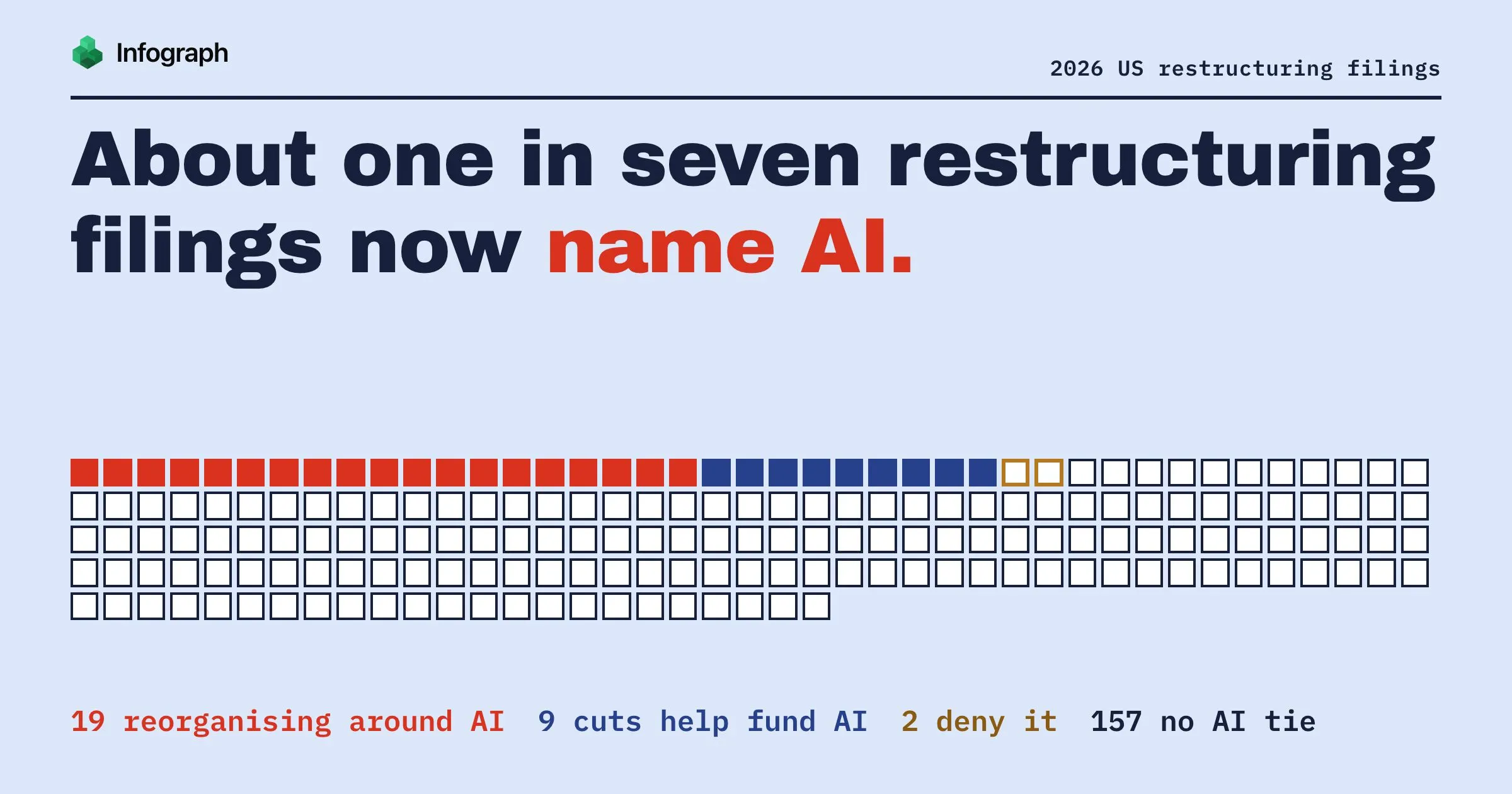
- Companies now put AI in writing. 28 of 187 restructuring filings in 2026 name AI as part of the plan, about one in seven. In 2023 it was 3 of 456.
- It means different things. In 19, the company is reorganising around AI, and about ten of those say AI lets them run with fewer people. In 9, the cuts help pay for AI. AI is often one reason among several, and 2 filings say it isn’t the reason.
- The wider numbers are less clear. Cuts citing AI, in the count most headlines use, fell about 90% from May to September. Amazon, Meta and Microsoft announced 2026’s largest cuts and made no such filing. Software postings peaked nine months before ChatGPT, but jobs in accounting, advertising and computer systems design have slipped since, and layoffs in the information sector are up to 50,600 a month.
Made with Infograph
Crunched the data
337,366 records from 7 sources
Found the pattern
28 of 187 filings name AI in the plan, up from 3 of 456 in 2023
Built the report
Connect your apps and databases. Infograph scans gigabytes of data, not just what fits in a chat window, and hands back results.
No credit card required
“AI” is the most cited reason for US job cuts this year, according to the count most headlines use. But are companies really laying people off because of AI, or is that just what they say?
To find out, we looked at what they file. When a US public company commits to a major restructuring, it has four business days to report it to the SEC in a Form 8-K, under Item 2.05. We found 1,254 of these filings since January 2023. We searched each one and its attachments for AI and automation, read what they said, and sorted them one by one.
The short answer: some companies now say so in writing, but these records can’t show how many jobs that adds up to.
Infograph sells AI that does work analysts used to do, so we have a stake in the answer. You can check every number here in the report or the filings it links to.
- 2026 restructuring filings that name AI as part of the plan: 28 of 187. It was 4% in 2025 and 2% in 2024
- 15%
- Source: SEC EDGAR, Item 2.05, our coding
- Fall in US job cuts citing AI from May to September 2026, in the count most headlines use: 38,579 to 3,961
- 90%
- Source: Challenger, Gray & Christmas
- Jobs cut in 2026 at Amazon, Meta and Microsoft, none with an Item 2.05 filing this year
- 33,236
- Source: Layoffs.fyi, SEC EDGAR
What we analysed
No single source can answer this, so we compared what companies tell investors, what they tell the state, what they announce and what happened to jobs:
SEC EDGAR, Form 8-K Item 2.05. US Securities and Exchange Commission, 3 January 2023 to 3 November 2026. Restructuring filings found by full-text search, main document and press release or memo exhibits, searched for AI and automation terms. The passages found were read and sorted, and each quote checked word for word. Open the original.
- filings searched
- 1,254
- companies
- 800
- coded with a quote
- 57
New York WARN dashboard. New York State Department of Labor, Read 3 November 2026. The stated reason on each layoff notice, for the only state we know of that asks about AI. Contact names and phone numbers were not kept. Open the original.
- notices read
- 1,616
- since March 2025
- 810
WARN Index. 48 state sources, CC BY 4.0, Snapshot 3 November 2026. Where AI-citing companies filed layoff notices, and a check on the New York list. Open the original.
- notices
- 96,083
Layoffs.fyi. Roger Lee, free with attribution, To 29 October 2026. Reported tech layoffs by company and year. About a third of events carry no count, and we left out two rows that are year-long headcount falls. Open the original.
- events
- 4,648
US Bureau of Labor Statistics. Current Employment Statistics and JOLTS, To September 2026. Jobs by sector before and after ChatGPT, and hires, layoffs and openings in the information sector. Open the original.
- monthly values
- 2,807
- series
- 24
Indeed Hiring Lab. CC BY 4.0, To 23 October 2026. Daily job postings for 47 kinds of work since February 2020. Open the original.
- values
- 230,958
Challenger, Gray & Christmas. Monthly job cut reports, January to September 2026. Announced US job cuts by stated reason. Our monthly AI figures add up to its reported total. Open the original.
- monthly reports
- 9
Analysed in Infograph. Eight tables, queried in one place, so we could compare each filing with the company's layoffs, its state notices and the wider jobs data. Open the interactive report.
How many restructuring filings name AI
This year, 28 of 187. Block cut more than 40% of its workforce and told investors it could “move faster with smaller, highly talented teams using AI to automate more work”. Cloudflare cut about 20% to “accelerate its evolution to an agentic AI-first operating model”. Angi cut about 350 people “in light of AI-driven efficiency improvements”.
That share has climbed quickly: 2% of filings in 2024, 4% in 2025 and 15% this year. But fewer companies are filing at all. There were 456 filings in 2023, 351 in 2024, 260 in 2025 and 187 so far this year. And 157 of this year’s filings don’t link the plan to AI. Even when they do, AI is often one reason among several. Coinbase lists “current market conditions” first. The two black boxes, in 2024 and 2025, are companies saying AI hurt their business.
What “because of AI” means in a filing
The 28 filings fall into two groups. In 19, the company is reorganising around AI. As we read them, about ten of those say outright that AI lets them run with fewer people: Angi, Block, Cloudflare, Commerce.com, Dow, Ecolab, Latch, Playtika, reAlpha and Snap. In the other 9, the cuts help pay for AI, often alongside other priorities. Pinterest is “reallocating resources to AI-focused roles and teams”. Atlassian was more direct: “self-fund further investment in AI and enterprise sales”.
The two groups overlap. Atlassian’s memo asks whether AI is replacing these roles, and answers: “Our approach is not ‘AI replaces people’. But it would be disingenuous to pretend AI doesn’t change the mix of skills we need or the number of roles required in certain areas. It does. This is primarily about adaptation.” We put each filing in the group it emphasises most, and that’s our judgement, not the company’s.
Two filings say the opposite. HubSpot’s memo says “This is not driven by AI-related efficiencies”, though it also says its strategy has shifted to “delivering outcomes for them with AI”. Etsy’s says “these decisions weren’t driven by AI”. Autodesk, which we count in the funding group, says its cuts are not “an effort to replace people with AI”.
Why the biggest layoffs are missing from the filings
A company only has to file under Item 2.05 when a plan is material to its business, and even a large layoff may not be material to a giant. Amazon, Meta and Microsoft announced the largest cuts of 2026 on Layoffs.fyi, 33,236 jobs between them, and we found no Item 2.05 filing from any of them this year. Amazon’s New York notices say “Economic”, and of its October 2025 round, its chief executive told investors: “it’s not even really AI-driven, not right now at least”.
Oracle hasn’t filed one either, but the biggest AI-linked plan we found is in its annual report. Its 2026 restructuring plan will cost up to $2.1 billion and aims to “further improve operational efficiencies, including through the adoption and integration of AI technologies across certain functions”. Its list of risks adds that using AI has “resulted, and may continue to result, in reductions to our workforce”. It doesn’t say how many jobs that means. We didn’t count annual reports, so there may be others like it.
Layoffs.fyi lists 21,000 cuts at Oracle and 11,000 at Dell this year. Both figures are actually falls in headcount over a financial year, not announced layoffs, so we left them out of the totals below.
So these filings show what companies say when they’re required to say something. They don’t tell us how many jobs AI has taken.
The AI layoffs number in the headlines is falling
The number in most headlines comes from somewhere else, and shouldn’t be added to these. Challenger, Gray & Christmas, an outplacement firm, counts announced job cuts each month. It has counted 120,136 US cuts this year that cited AI, more than any other reason. But the monthly number has fallen about 90%, from 38,579 in May to 3,961 in September, when AI ranked fifth. Total announced cuts are down 39% on last year, or 15% excluding government. Challenger itself warns of “the ambiguous nature of what constitutes AI-attributed cuts”.
New York asks about AI layoffs
In March 2025 New York added a question to its layoff notice: did “technological innovation or automation” contribute? It is the only state we know of that asks. In May 2026 a law firm reported that more than 160 companies had filed in the first year and not one notice had attributed a layoff to AI.
The answers to that question aren’t published, so we can’t check this. But each notice does give a reason for the layoff, so we read them. Of 810 notices since March 2025, the most common reasons are economic ones and lost contracts. One, from January 2026, names AI: Nespresso, 46 workers in New York City, “Relocation of Business, Artificial Intelligence”.
It’s tempting to compare that single notice with Challenger’s 120,136 and call it a cover-up. But that comparison doesn’t work. We could match seven of this year’s AI-citing companies to state layoff notices, 15 in all, 11 of them in California. None was in New York. Those notices don’t give a reason, and we couldn’t confirm a match for the other 21 companies.
Jobs before and after ChatGPT
ChatGPT launched on 30 November 2022, so we compared the 33 months before it with the 46 months since. US payrolls are up 3.1% and health care jobs 14.5%. Of two fields often said to be at risk, legal services is up 5.8%, while management consulting is up 3.7% after growing 16% in the shorter period before.
Other desk work has slipped after growing before ChatGPT: accounting is down 1.1%, advertising and PR 4.4%, and computer systems design 5.1%. Temp help, which covers far more than desk work, is down 18%.
Some of the falls started earlier. Call centre and business support jobs are down 19%, but had already fallen 12% before ChatGPT launched. The information sector is down 12%, but it includes film and phone companies, and November 2022 was its peak. Software publishers are down 1.7%, after growing 32% in the 33 months before.
This year looks worse for the information sector, so this isn’t all noise. Layoffs averaged 50,600 a month from January to September, up from 36,900 in the same months of 2025. Job openings are the lowest since at least 2019, though hires rose slightly. These figures are small, rounded and not seasonally adjusted.
Software job postings peaked before ChatGPT
Software job postings on Indeed reached 229 in February 2022, where 100 is the level just before the pandemic. By the time ChatGPT launched they had already fallen to 147. The hiring boom was ending, and the Federal Reserve had started raising interest rates that March. This data can’t separate those causes from AI.
Over the past year software postings rose 22%, though they’re still 46% below November 2022. Tech layoffs are harder to read: Challenger’s technology count is up 54% through September, while Layoffs.fyi is down 7% once the Oracle and Dell figures are removed.
The steepest falls are mostly in desk jobs. Data and analytics, the field closest to what Infograph sells, has fallen most, by 55%. The median across 47 job types is 31%. That could be AI. It could also be the end of a boom, since most of those job types peaked well before ChatGPT. Childcare is down 49% too, but it followed a different path, peaking in November 2022.
Are layoffs really because of AI?
At some companies, by their own account, yes. About ten say in a filing this year that AI lets them run with fewer people. Nine more say the cuts help pay for AI, which tells you where the money is going but not who does the work now.
How many jobs that adds up to is another matter. The largest cuts of the year sit outside these filings, and the count in the headlines fell about 90% between May and September. Job postings for desk work mostly peaked before ChatGPT launched, yet payrolls in several desk fields have slipped since.
So AI is a stated reason at a small share of companies. These records can’t show that it’s behind a wider loss of jobs, and they can’t rule it out either.
We could only make these comparisons by putting 1,254 filings, 1,616 notices and 230,958 job posting figures in one place. Most of what a business wants to know about itself is scattered in the same way.
What could make this wrong
A filing is only a claim. A company might name AI because it’s true, or because it’s what it wants investors to hear. We can show what was said, not whether it’s true.
Not mentioning AI proves nothing. A company may have its own reasons not to name AI to a regulator or its staff. So a form that doesn’t mention AI doesn’t show AI played no part.
Our count involves judgement. We counted a filing when it says AI is a purpose of the plan, makes the plan possible, is where the money is going, or hurt the business. We didn’t count AI mentioned only as a product or market, or filings that mention only automation. Without our four weakest calls (Bancorp, Comscore, Playstudios, Rapid7), the 2026 count is 24 of 187. With three near misses (Intuit, Upwork, C3.ai), it’s 31. Filings mentioning AI in any way, including standard legal wording, number 33 in 2023, 31 in 2024, 39 in 2025 and 48 so far this year. In the report, each filled box opens its quote and filing.
Item 2.05 misses a lot. It only covers public companies, and only plans they consider material, so the largest cuts and every private company are outside it. It also includes some amended filings and plans with no job cuts, such as write-offs. Repeat filings stay in the total, though we count each plan’s AI link once.
We didn’t read every filing in full. We stopped if a filing’s main document and attachments never mentioned AI or automation. We built our list with a full-text search, and a later check of company filing histories found at least 18 more from 2023 to 2025, which we haven’t read. It found none from 2026.
November 2022 isn’t a clean starting point. It’s near the top of a hiring boom and months into interest rate rises. So before and after here shows timing, not cause.
New York’s list has a gap. WARN Index lists two Meta notices from May 2026, covering 1,160 workers, that aren’t in the state’s list, so we don’t know what reason Meta gave.
This report describes public records as of 3 November 2026. It doesn’t forecast jobs, and it isn’t career, investment or legal advice.
Analyze your data with frontier AI, at scale
Upload your data, connect your apps and databases in seconds. Infograph enables frontier models to scan gigabytes of data, not just what fits in a chat window, and hands back results, data reports and live dashboards.