Data report
Godzilla Minus Zero Budget: Nearly Half the Films at Its Price Don't Gross Their Budget
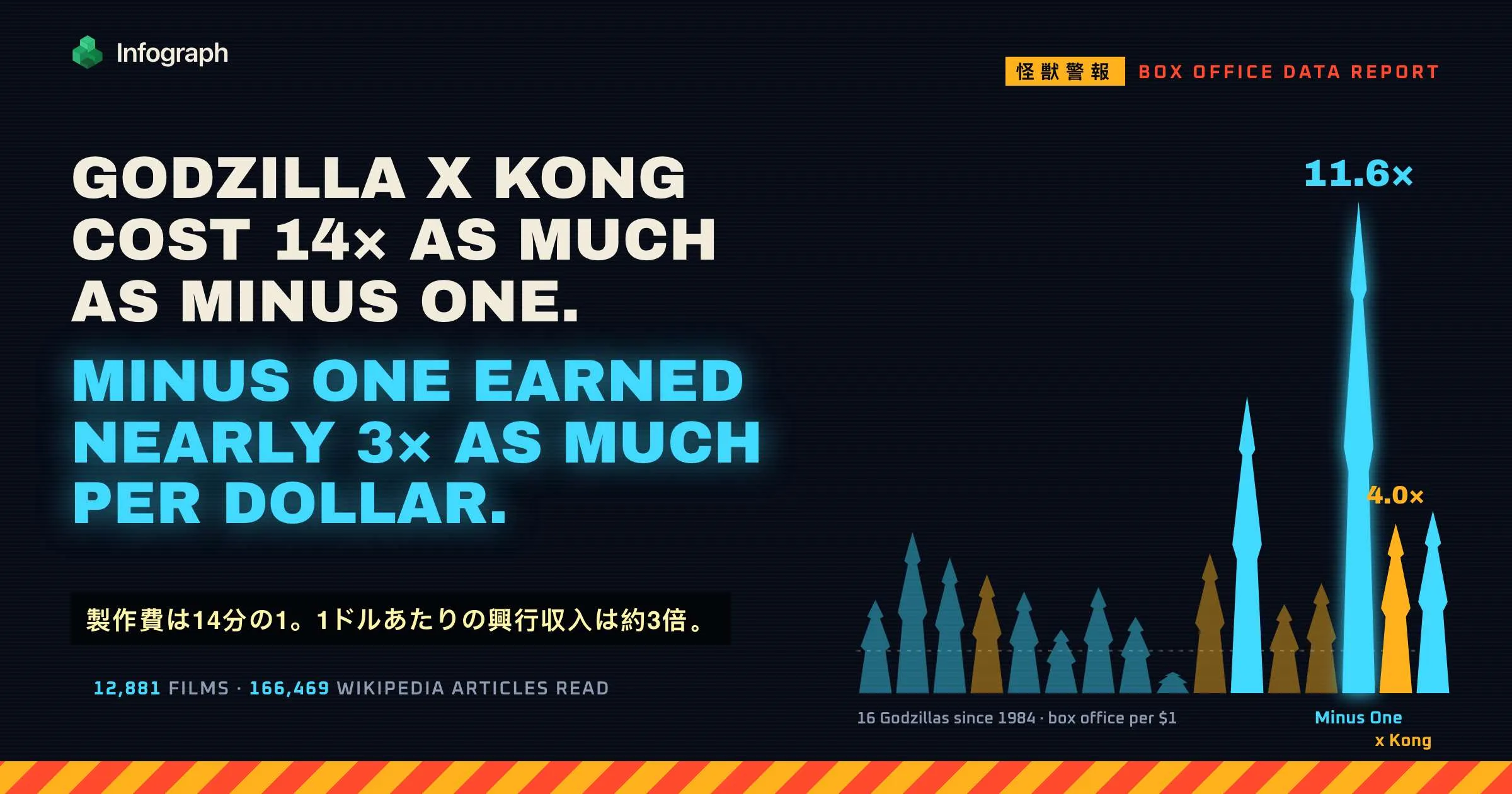
Godzilla x Kong cost 14 times as much as Minus One. Minus One earned nearly 3 times as much per dollar, at a budget where nearly half of films fall short.
Key takeaways
- Godzilla x Kong cost 14 times as much as Godzilla Minus One. Minus One grossed 11.6 times its reported $10 million budget. Godzilla x Kong grossed 4.0 times its $135 to $150 million.
- Blockbusters rarely fall short. Of 335 cinema releases made for $200 million or more since 1980, only 20 grossed less than they cost: about 1 in 17. Even at twice the budget, they fall short far less often than mid-budget films.
- Godzilla’s budget range is among the riskiest. Of 3,538 films made for $10 to $30 million, 1,712 grossed less than their budget. Only 102, Minus One among them, grossed 11.6 times theirs, and Japan’s older Godzillas did no better than Hollywood’s.
Made with Infograph
Crunched the data
166,469 Wikipedia film articles, 12,881 cinema releases compared in today's dollars
Found the pattern
1 in 17 films made for $200M or more grossed less than their budget; at Godzilla's $10M to $30M, 1,712 of 3,538 did
Built the report
Connect your apps and databases. Infograph scans gigabytes of data, not just what fits in a chat window, and hands back results.
No credit card required
Godzilla Minus Zero opened at number one in North America on the weekend of 6 November. It’s a subtitled, R-rated film with a reported budget of $13 to $18 million, and it took $30.6 million in its first weekend there, a record for a foreign-language film. In 2023 its predecessor, Minus One, became a hit on about $10 million and won the Oscar for visual effects.
So the internet has its verdict: Hollywood wastes its money. Its own Godzilla films cost ten times more and earn less per dollar, so big budgets must be the problem.
The Godzilla numbers are right. The conclusion isn’t how films usually work. We read the budget and box office of every film on English Wikipedia to find out, and the answer makes Godzilla look stranger, not more obvious.
- Films made for $200M or more (today's dollars) that grossed less than their budget: 20 of 335
- 1 in 17
- Source: Wikipedia infoboxes, cinema releases 1980 to 2026
- Of the 3,538 films made for $10M to $30M that grossed less than their budget, nearly half
- 1,712
- Source: Wikipedia infoboxes, cinema releases 1980 to 2026
- Godzilla Minus One's box office over its reported $10M budget. Only 102 films in its budget range, Minus One included, did as well
- 11.6×
- Source: Wikipedia, Godzilla Minus One
What we analysed
Every film’s budget and box office sits in the infobox on its Wikipedia page. We read all of them and crunched them in Infograph, in one currency and today’s money:
English Wikipedia film articles. Wikipedia, CC BY-SA 4.0, Read 11 November 2026. The budget and box office in every article about a single film that uses the film infobox. Ranges were taken at their midpoint, a net budget where gross and net are both given, and box office figures for one country or region, or studio rentals, were left out. The template asks for the worldwide box office; some older films give only a domestic figure. Open the original.
- film articles read
- 166,469
- with a budget and a box office
- 17,857
- currencies
- 24
World Bank official exchange rates. World Development Indicators, 1960 to 2025. Each currency's annual average rate against the dollar, to convert a budget or box office in yen, rupees or euros in the year the film came out. Open the original.
- currency years
- 1,820
- currencies
- 29
US Bureau of Labor Statistics, consumer prices. CPI-U, all items, 1913 to October 2026. Inflation, to put a 1985 budget and a 2025 budget in the same dollars. Open the original.
- monthly values
- 1,365
Analysed in Infograph. One table of films in today's dollars. We left out films released on streaming services and the cinema closures of 2020 and 2021, which leaves 12,881 cinema releases since 1980 to compare. Open the interactive report.
Every film since 1980 on one picture
Each dot is a film: its budget along the bottom, its box office up the side. The white line is break-even at the box office. A film on it grossed exactly what it cost. Red dots fell short.
The striped band is $10 to $30 million in today’s money, where Godzilla lives. Look how much red sits in it.
Blockbusters rarely fall short
Here’s the part that cuts against the internet’s verdict. Of the 335 films made for $200 million or more, 20 grossed less than their budget. That’s 6%, about one film in 17. The median blockbuster grossed nearly three times what it cost.
Of the 3,538 films made for $10 to $30 million, 1,712 fell short. That’s 48%, nearly one in two. The median film there grossed 1.07 times its budget, barely its money back.
Box office is what cinemas take at the till, not what the studio keeps, so grossing your budget is a low bar. Raise it to twice the budget and the big films still come out well ahead: 29% of the $200 million films fall short of that, against 68% in Godzilla’s range. A big budget doesn’t make a hit by itself, and most of them go to proven franchises. But they come with far better odds.
The smallest films look safer than they are. Of the films whose infobox gives a budget under $1 million in the dollars of the day, only 29% also give a box office, against 92% of films at $10 to $30 million. A film that sold almost no tickets often has no box office figure on its page at all, so the films that did badly are mostly missing from the bottom row. That’s why it’s faint.
The 20 blockbusters that missed anyway
Big money still isn’t a guarantee. These are the cinema releases made for $200 million or more in today’s dollars that didn’t gross their budget. You probably remember a few of them. They’re memorable because there are so few.
It isn’t because the films are Japanese
The easy explanation is that Japan simply makes monsters cheaper and better. Godzilla’s own history says otherwise, and it’s the cleanest test there is: the same monster, made on both sides of the Pacific.
The Japanese Godzillas of 1984 to 2004 with figures on record grossed between 0.5 and 3.8 times their budgets. Hollywood’s five grossed between 2.1 and 4.0 times theirs. No better, no worse. Godzilla: Final Wars grossed about half its reported cost in 2004, and Toho’s next Godzilla was twelve years away.
Then Shin Godzilla grossed 7.0 times its budget in 2016, and Minus One 11.6 times in 2023.
Five Godzillas from those years aren’t on the chart, because their infobox gives no budget, or only a Japanese or rentals figure: Godzilla vs. Biollante, vs. King Ghidorah, vs. Mothra, vs. SpaceGodzilla and Tokyo S.O.S.
One more caution about Godzilla’s numbers. Toho has never stated either Minus film’s budget. Minus One’s $10 million is the figure its Wikipedia article settles on: director Takashi Yamazaki put the cost between the $10 and $15 million the press reported, and denied it reached $15 million. Minus Zero’s $13 to $18 million rests on press reports and his remark to Filmmaker Magazine that it got “maybe 30 percent more” than the last film. Even at $15 million, Minus One would have grossed 7.7 times its budget, and only 205 of the 3,538 films in its range did that well: still the top 6%.
One of 102 out of 3,538
Of the 3,538 cinema releases made for $10 to $30 million since 1980, 102 grossed 11.6 times their budget or more. Minus One is one of them. That puts it in roughly the top 3% of the films made for its kind of money.
Minus Zero is still in cinemas. So far it has grossed $67.4 million, 4.3 times the midpoint of its reported budget, and 474 of the other films in its range reached that or more. It doesn’t need to match Minus One to have beaten the odds: at its budget, nearly half of films never gross their cost at all.
So does money buy a hit?
Not on its own, but it comes with much better odds. Across 12,881 films, the bigger the budget, the less often a film falls short at the box office, and about half of the films made for $5 million to $30 million fall short, among the worst odds in the record. That’s where Toho made Minus One and Minus Zero.
That’s what makes them remarkable. Cheap films are everywhere, and half of them fall short. Minus One took a budget that misses about as often as it hits and finished in the top 3% of it. You only see that with every film’s numbers side by side, in one currency and one year’s dollars. Comparing one film’s budget with another’s never shows it.
Analyze your data with frontier AI, at scale
Upload your data, connect your apps and databases in seconds. Infograph enables frontier models to scan gigabytes of data, not just what fits in a chat window, and hands back results, data reports and live dashboards.